
By Kalvin BrookesMoin Hamburg Tours
Hamburg rewards walking. The city centre is compact enough to cover on foot, but dense enough that a good guide saves you from missing the details that matter — why the Rathaus tower is exactly one metre taller than St. Petri, where the Great Fire of 1842 actually started, or how the Speicherstadt's warehouses stayed standing through two world wars.
This guide covers what to expect from a Hamburg walking tour, how to choose between the main neighbourhoods, and what separates a useful small-group tour from a generic city overview.
Why walk rather than bus or boat?
Bus tours give you coverage. Boat tours give you the harbour. Walking tours give you context — the kind you only get when you're standing in front of a building, reading the stone, and hearing what happened on that exact spot.
Hamburg's most interesting stories are tied to specific places: the Chilehaus brickwork in the Kontorhaus district, the Beatles' 98 nights at the Kaiserkeller on Große Freiheit, the customs border that ran through the Speicherstadt for 116 years. You need to be on the ground to understand why those facts matter.
For a first visit of two or three days, one or two walking tours usually works better than trying to see everything independently. You cover less ground, but you leave with a mental map of the city that makes the rest of your trip easier.
The three neighbourhoods worth prioritising
Most quality operators focus on three areas. Each has a different character and a different reason to visit.
Old Town — history, architecture, and the Great Fire
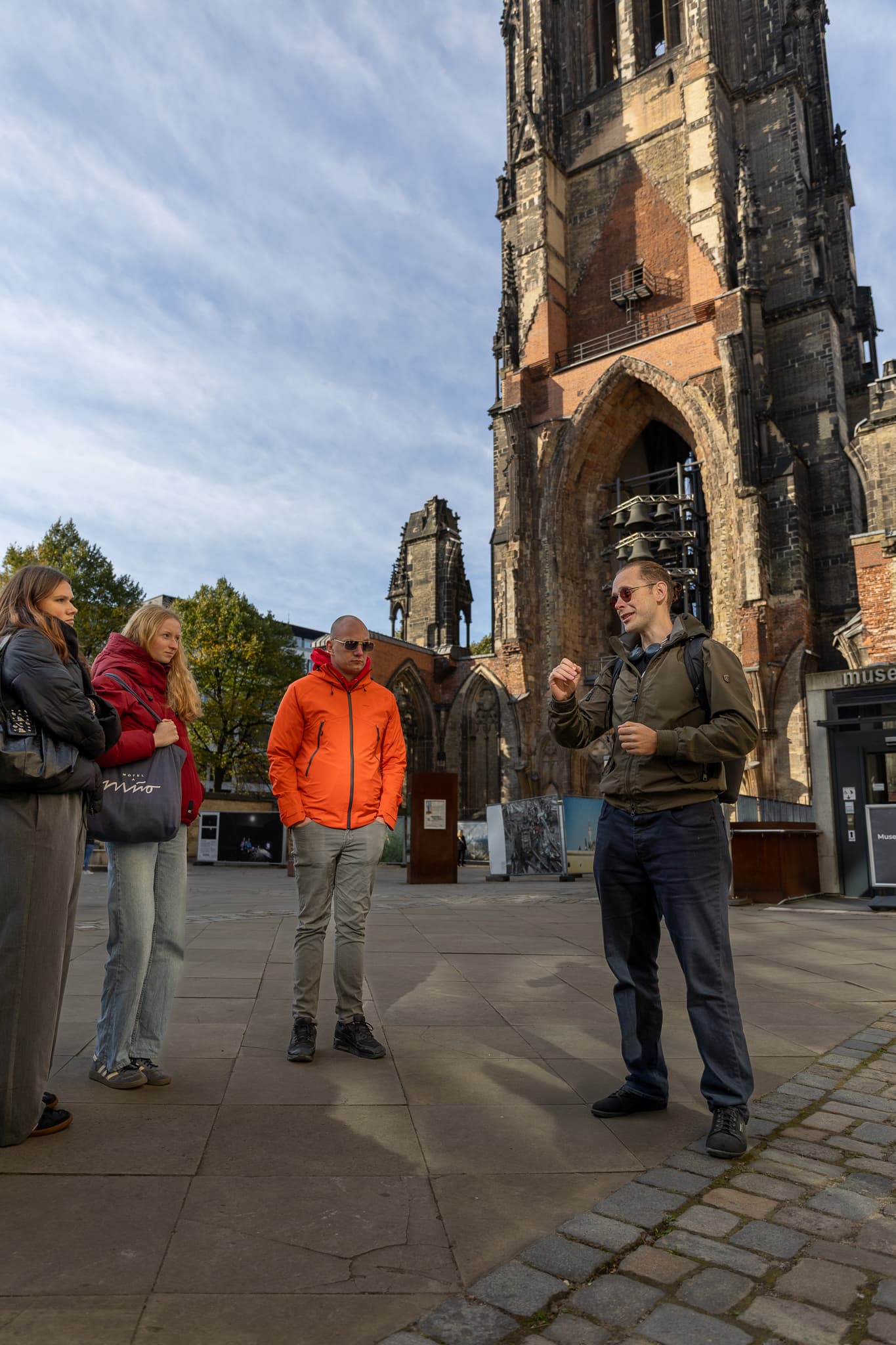
The Altstadt and surrounding streets hold Hamburg's oldest surviving fabric: the Rathaus (built after the 1842 fire), St. Nikolai memorial, Deichstraße's 17th-century houses, and the canals that shaped the port city.
An Old Town walking tour typically runs 2.5 hours and works well as a first tour — it establishes the timeline (Hanseatic league, fire, reconstruction, WW2, modern Hamburg) that everything else builds on.
Best for: First-time visitors, history-focused travellers, anyone who wants the city's chronological backbone.
St. Pauli & the Reeperbahn — port culture, not just nightlife
St. Pauli has a reputation, but the neighbourhood's historical significance runs deeper than the entertainment district. Hamburg's port workers lived here. The Beatles played their first 98 nights in the city at the Kaiserkeller in October–December 1960. The Elbtunnel, opened in 1911, connected the docks to the south bank long before the Elbphilharmonie existed.
A good St. Pauli tour frames the area as cultural and maritime history — not a pub crawl with commentary.
Best for: Music history fans, visitors who want something beyond the postcard sights, evening-adjacent tours that still finish at a sensible hour.
Speicherstadt & HafenCity — UNESCO warehouses and the Elbphilharmonie
The Speicherstadt is the world's largest warehouse district on timber-pile foundations — a UNESCO World Heritage Site since 2015. The red-brick warehouses, the bridges, the narrow canals, and the view across to the Elbphilharmonie (final cost: €866 million, built on the base of Kaispeicher A) make this the most visually distinctive part of central Hamburg.
The Speicherstadt tour covers customs history, coffee and spice trading, and the controversial HafenCity redevelopment. Expect cobblestones — relevant if you're travelling with a pushchair or have mobility considerations.
Best for: Architecture enthusiasts, photographers, visitors who already know basic Hamburg history and want something more specific.
What "small group" actually means
Group size affects the experience more than most listing pages admit. At 30 or 40 people, you're following a flag and straining to hear. At 15 or fewer, you can ask questions, hear without a microphone, and actually stop at narrow points without blocking half the street.
Moin Hamburg Tours caps join-in groups at 15. That's a deliberate choice — not a marketing line. Guides can adjust pace, repeat a point for someone at the back, and take questions without holding up a crowd.
If you're comparing operators, ask about maximum group size before booking, not just the advertised "small group" label.
How long to allow
| Tour type | Typical duration | What you get |
|---|---|---|
| Old Town | 2.5 hours | Chronological city history, Rathaus, St. Nikolai, canals |
| St. Pauli | 2 hours | Port district, Beatles history, Reeperbahn context |
| Speicherstadt | 2 hours | Warehouses, Elbphilharmonie, HafenCity |
| Private tour | 2–3 hours (flexible) | Custom route for your group |
For a weekend trip, one join-in tour plus independent exploring on day two is a solid plan. Two tours — Old Town plus either St. Pauli or Speicherstadt — works well if you're in Hamburg for three days and want depth rather than breadth.
Languages, booking, and what to bring
Hamburg attracts international visitors, but not every tour runs in every language. Check before you book — especially if you prefer German or Spanish rather than default English.
Moin Hamburg Tours runs scheduled join-in tours in English, German, and Spanish with local guides. Private tours can be arranged in all three languages, including dedicated Spanish-language groups — still relatively rare among Hamburg operators.
Practical notes:
- Footwear: Cobblestones in the Speicherstadt; comfortable shoes beat fashion every time.
- Weather: Hamburg rain is real. A light waterproof layer is worth packing even in summer.
- Booking: Reserve ahead in peak season (May–September, December market weeks). Same-day spots exist but aren't guaranteed.
Join-in tour or private?
Join-in tours suit solo travellers, couples, and small groups who want a scheduled departure at a fixed price (from €35/person for MHT join-in tours, plus booking fee).
Private tours suit families, friend groups, corporate teams, and school parties who want their own guide, their own pace, and a route matched to their interests. Pricing is tiered by group size — direct booking by phone or WhatsApp avoids the online booking fee.
If you're travelling with children under 10 or have specific accessibility needs, a private tour is usually the better conversation to have upfront rather than hoping a public departure will adapt.
A reasonable first-timer itinerary
Day 1 — Old Town tour (morning or afternoon) + harbour walk at dusk. The tour gives you the historical frame; an independent stroll along the Landungsbrücken or through HafenCity at sunset costs nothing extra.
Day 2 — Speicherstadt or St. Pauli tour + Elbphilharmonie plaza. Pick whichever neighbourhood interests you more after day one.
Day 3 — Alster lakes, Sternschanze, or a return to whichever area you wanted more time in.
You don't need to book all of this in advance. One walking tour at the start of your trip is usually enough to orient yourself — the rest follows naturally once you know which stories you want to pursue.
The bottom line
Hamburg walking tours are worth it if you choose the right neighbourhood and a group size that lets you actually hear the guide. Old Town for history, St. Pauli for culture and music, Speicherstadt for architecture and harbour context — pick one that matches your interests, book ahead in busy months, and treat it as the start of exploring rather than a box to tick.
If you're ready to book, see today's available tours or browse the Old Town, St. Pauli, and Speicherstadt tour pages for dates, times, and what's included.
PLAN YOUR VISIT
See Hamburg with a local guide
Small-group walking tours in English, German and Spanish — Old Town, St. Pauli, and Speicherstadt.
See our tours →